
AI Should Learn Like Children: A Hypothesis on Artificial Intelligence, Cognitive Development, and the Limits of Statistical Minds
Versão em português AI deveria aprender como crianças
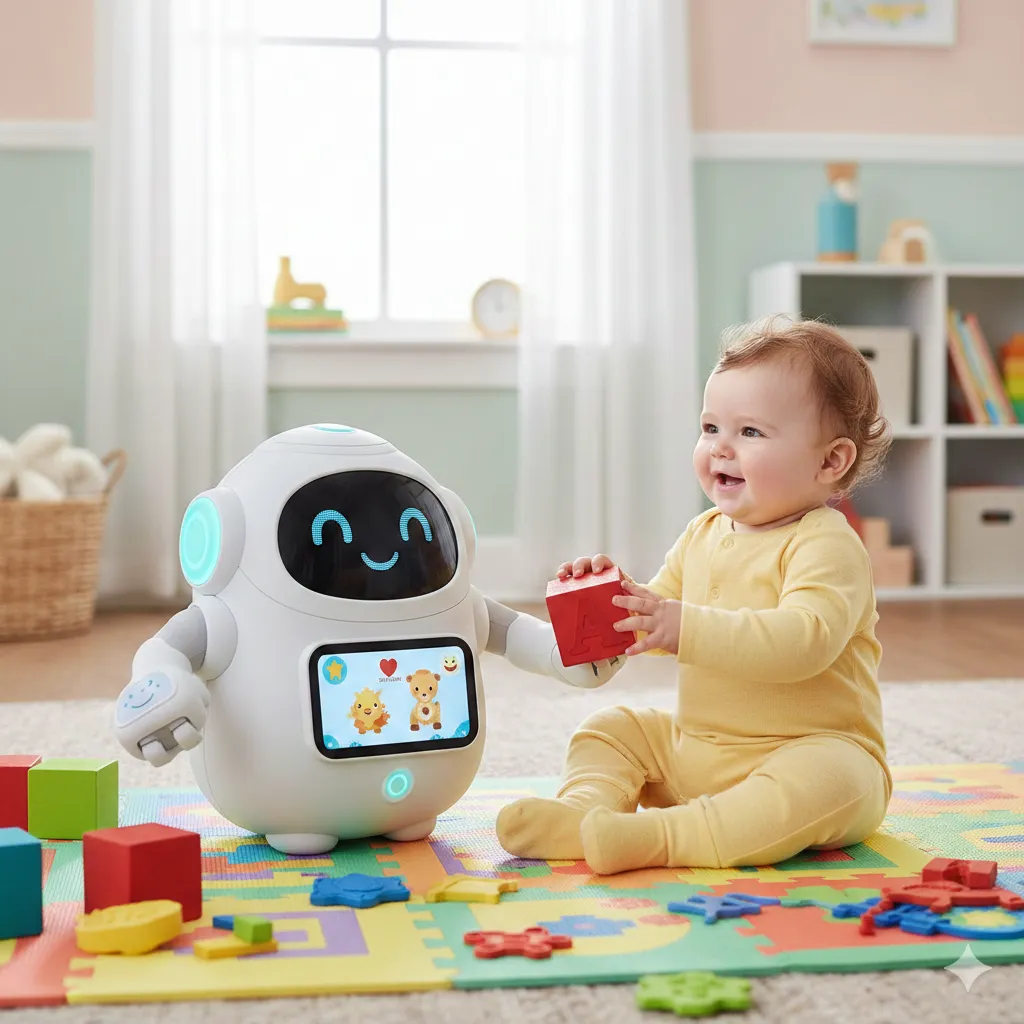
This is the English translation of the original Portuguese essay ‘AI deveria aprender como crianças’.
“Intelligence is the efficiency with which a system acquires new skills outside its training domain.” — François Chollet
“The problem is not to build a machine that thinks, but to build a machine that learns to think.” — Yann LeCun
Introduction: The Invisible Bottleneck
There is a scene that repeats itself, with variations, in AI laboratories around the world. A state-of-the-art language model — trained on quantities of text no human could read in a thousand lifetimes — is presented with a simple visual reasoning problem: given a 3×3 grid with color patterns, infer the rule and complete the fourth example. The model fails. Not occasionally, not under adversarial conditions. It fails systematically, while a four-year-old child, armed only with her eyes and insatiable curiosity about how things work, would solve the same problem in seconds.
This essay begins with that disconcerting asymmetry — not to diminish the magnitude of what large language models have achieved, but to investigate what it reveals about the nature of intelligence, the limits of current architectures, and what any serious hypothesis about Artificial General Intelligence ought to contemplate.
The central thesis is a philosophical-technical hypothesis: AGI cannot emerge from architectures of passive learning and static structure, and the most promising path runs through the emulation of the cognitive mechanisms of infant development — intrinsic curiosity, evolutionary priors, dynamic world models, and continuous learning anchored in embodiment.
Part I: The Triumph and the Ceiling — What LLMs Conquered and Where They Stopped
1.1 The Language Revolution as Latent Space
To understand where large language models have failed, it is first necessary to appreciate — with the seriousness the achievement deserves — what they have accomplished. Language is not merely a medium of communication. It is, arguably, the most powerful cognitive technology our species has developed: a symbolic compression system that allows concepts to be transmitted, combined, and recombined across time and space.
LLMs, by learning to model the statistical distribution of language sequences at industrial scale, have done something that should not be underestimated: they have captured, in their weights, a functional shadow of the human conceptual network. When we ask GPT-4 or Claude Sonnet about the relationship between entropy and information, or ask them to explain the intuition behind Bayes’ Theorem, these models frequently produce responses that are not merely correct, but pedagogically sophisticated — responses that reflect structural understanding of the relations between concepts, not merely retrieval of surface patterns.
1.2 The Scaling Barrier and the ARC-AGI Problem
But the scaling laws are reaching their end. Returns on adding parameters and data are diminishing. And there is one benchmark that captures the problem with surgical precision: the ARC-AGI (Abstraction and Reasoning Corpus for Artificial General Intelligence), developed by François Chollet.
The ARC-AGI is elegantly simple in its structure and devastating in its implications. The system receives pairs of input-output examples — typically colored grids demonstrating a visual transformation — and must induce the governing rule and apply it to a new input case. The examples are few: usually three or four. The rules involve concepts like symmetry, counting, topological correspondence, spatial continuity — concepts that a four-year-old masters intuitively. The best language models, even the most advanced, perform modestly on ARC. The diagnostic is clear: LLMs have learned to interpolate within the distribution of their training data with extraordinary sophistication. But when confronted with situations that require synthesizing new rules from few examples — what cognitive psychologists call “few-shot inductive learning” — the statistical mechanisms underpinning the transformer are simply not the right tools for the job.
1.3 The Structural Problem: Passivity, Stasis, Disembodiment
Beyond ARC, there are three structural limitations of LLMs that any AGI hypothesis must confront directly.
The first is passivity. An LLM learns by observing text — an extraordinary amount of text, but text produced by others, capturing others’ thoughts, describing others’ experiences. The model never acts in the world. Never tests a hypothesis. Never discovers its prediction was wrong through a real physical consequence. The difference between learning that “eggs break when they fall” by reading that sentence and learning the same by dropping an egg from one’s hand is a difference of kind, not merely of degree.
The second is stasis. Once trained, the weights of an LLM are fixed. The model you consult today is identical, in terms of its internal parameters, to the model of yesterday — regardless of how many interactions it has had. The biological brain solves this problem elegantly, through mechanisms that allow the consolidation of new memories without erasing old ones.
The third is disembodiment. An LLM has no body. It has no proprioception. It does not experience resistance, gravity, temperature, texture. Its concepts of “heavy,” “hot,” “rough,” “distant” are statistical relations between symbols — patterns of co-occurrence in text — not representations anchored in sensorimotor experience. There are both empirical and theoretical reasons to believe that a substantial portion of human cognition — including high-level abstract reasoning — is built on sensorimotor foundations. Removing those foundations may not be merely a pragmatic limitation; it may be a constitutive one.
Part II: What a Child Knows — Cognitive Development as a Model
2.1 Born with Priors: The End of the Blank Slate
The classic empiricist view of the infant mind — the tabula rasa — is empirically false. The research of Elizabeth Spelke, Karen Wynn, Renée Baillargeon and others has demonstrated that newborns arrive in the world equipped with a rich set of expectations about how reality works. Spelke termed these “Core Knowledge” and identified several domains in which it operates: physical objects (cohesion, continuity, contact), agents (intentionality, means-rationality), number (quantity comparison, counting principles), and geometry (spatial navigation, topological relations).
This Core Knowledge is not learned from experience — it is present from birth, the product of millions of years of evolutionary selection. A four-month-old infant demonstrates surprise when a solid object appears to pass through another solid object — a violation of impenetrability the infant never needed to learn explicitly. The implication for AI is direct: architectures that initialize with random weights — with no structured prior about how the world works — are at a fundamental disadvantage relative to human learning. It is not a question of data quantity; it is a question of initial structure.
2.2 Active Learning and Curiosity as Algorithm
Observe an eighteen-month-old for an hour. What you will see is a remarkably efficient learning system operating in active, self-directed search mode. The child does not wait to be taught. She explores. She manipulates objects, tests their properties, forms expectations, checks those expectations, and revises her mental model when expectations are violated.
Pierre-Yves Oudeyer and collaborators formalized this process with the concept of “Learning Progress” as an intrinsic attention mechanism. The thesis is that children — and hypothetically AI systems inspired by them — do not distribute their attention randomly across possible explorations. They focus on situations where they are actively learning: where prediction error is decreasing, where the internal model is being productively revised. There is something philosophically profound here. Curiosity, often treated as a mysterious emotion, reveals itself as an optimization mechanism — a gradient signal that orients an agent’s exploration through the space of possible experiences so as to maximize learning efficiency.
2.3 Embodiment as Foundation — Not Detail
Jean Piaget made an observation that is frequently cited but rarely taken seriously in its radical implications: cognitive development begins in the sensorimotor stage. The child does not learn to think in abstractions and then apply that thinking to the physical world. She learns to think through interaction with the physical world. Abstract thought emerges from concrete action, not the other way around.
Contemporary neuroscience adds a layer: the neural representations of abstract concepts retain functional traces of their sensorimotor origins. When we think about “grasping,” motor areas of the cortex activate. When we process social temperature metaphors (“she was cold to me”), the insular cortex — which processes physical temperature — shows activation. If this is correct — and there is substantial evidence suggesting it is — then AI systems that process language without any sensorimotor experience are building conceptual edifices on missing foundations.
Part III: The Thought Experiment — The Curious Child’s Room
3.1 The Philosophical Room Tradition
Philosophy of mind has produced, in recent decades, a series of thought experiments that have become landmarks of the debate on consciousness, intentionality, and cognition: Searle’s Chinese Room, Jackson’s Mary’s Room, Putnam’s Brain in a Vat, Chalmers’ Philosophical Zombies. These experiments are not empirical arguments; they are conceptual devices — tools for testing intuitions, revealing hidden assumptions, and illuminating distinctions that ordinary discourse tends to obscure.
3.2 The Curious Child’s Room: Description of the Experiment
Imagine two rooms. In each room there is a child — or what appears to be a child. But the rooms are structurally very different.
The first room is the Statistical Child’s Room. In it, we find a system that received, before being placed in the room, all the scientific and popular literature ever produced on physics, chemistry, biology, psychology, and engineering. If you ask this system what happens when a ball rolls down a ramp, it produces a precise and sophisticated description of the relevant kinematics. But the room is empty. There are no objects. No ramp, no ball, nothing to manipulate. The system never pushed anything. Never saw an object roll. When you place a ball in the room for the first time and push it toward the system — it doesn’t catch it. Doesn’t react adaptively. Simply produces more text describing what should be happening.
The second room is the Curious Child’s Room. In it, there is no library. No manuals. There is only an agent — endowed, like a human infant, with certain structural priors about reality — and a room full of objects: wooden blocks of different sizes and weights, ramps of varying inclination, containers of different shapes, strings, springs, weights, pulleys. No instructions. No curriculum. Just the agent, the objects, and time.
What does the Curious Child do? She explores. Picks up a block, drops it — observes. Picks up another, larger one — drops it — notes it fell with a different sound. Stacks blocks, watches the tower fall — rebuilds more carefully. Places an object on the ramp — watches it roll — changes the angle — notes it rolls faster. In each cycle, she does something precise: formulates an implicit hypothesis, tests it through action, observes the result, and updates her internal model of how the world works.
3.3 The Decisive Test
You place in each room a device never described in any text — a simple but novel mechanism: a lever with an asymmetrically positioned fulcrum, connected to a closed box by a cable. The task: open the box.
The Statistical Child produces a textually sophisticated analysis. Identifies that there is a lever. Mentions the principle of the fulcrum. Perhaps quotes Archimedes. But when confronted with the need to physically interact with the mechanism — to calibrate how much force to apply, in which direction, what the expected behavior of the cable is when the lever moves — she floats in a space of uncertainty her library cannot resolve.
The Curious Child looks at the mechanism. Has no vocabulary for “lever” or “fulcrum.” But has something more powerful: a world model calibrated by experience. She sees a rigid object with a support point. She already knows, from her explorations, that rigid objects supported at a point behave in certain ways when you push one end. She sees the cable. Already knows that cables transmit force. She formulates a hypothesis, acts, observes the result, adjusts. Within minutes, the box is open.
This is the core of the thought experiment. It does not say the Statistical Child is stupid or useless. It says she possesses a different kind of competence — extraordinary in her domain, but structurally inadequate for the task of novel generalization from few examples. The difference is not merely quantitative (more data, more parameters) but qualitative: it is a difference in the type of internal representation each system built and the process by which it built them.
Part IV: The Architectural Hypothesis — Toward a Model of Infant Learning
4.1 The Five Pillars of the Hypothesis
Based on the preceding analysis, the central hypothesis can now be articulated more precisely. The hypothesis is not that we should simply “emulate children” in some vague, inspirational sense. It is that there are five specific mechanisms of infant cognitive development that are computationally relevant and that any serious AGI architecture must address.
Pillar 1: Initialization with structural priors. An AGI architecture should not start from absolute zero. It should be initialized with a set of inductive biases inspired by human Core Knowledge — structural predispositions to process object cohesion, permanence, contact causality, intentional agency, and basic numerical relations.
Pillar 2: Self-directed exploration through intrinsic curiosity. Rather than being fed curated datasets, the agent should guide its own data collection through an intrinsic reward mechanism based on learning progress — the derivative of the world model’s prediction error.
Pillar 3: Predictive world model in latent space. Rather than learning to predict sequences of raw observations (pixels, tokens), the system should learn to construct and maintain a world model in latent space — a mental simulator that allows counterfactual planning before action. This is the pillar most directly aligned with Yann LeCun’s proposals on JEPAs.
Pillar 4: Continuous learning without catastrophic forgetting. The system must be capable of learning from new experiences without destroying what it learned from previous ones. This requires architectural mechanisms beyond simple backpropagation — possibly inspired by the hippocampal-neocortical interaction that neuroscience identifies as central to memory consolidation.
Pillar 5: Embodiment — or its artificial analogue. The system cannot learn only by observing; it must act and observe the consequences of its actions. This may be realized through physical robotics, high-fidelity simulations, or virtual environments with realistic physics — but the learning structure must be action-consequence, not observation-only.
4.2 Architectures That Attempt the Path
Several research programs attempt to advance toward some of these pillars. Liquid Neural Networks (Hasani et al., MIT) model neuron dynamics through nonlinear ordinary differential equations, enabling real-time adaptation of internal representations during inference. State Space Models (particularly Mamba, by Gu and Dao) offer computational efficiency for long sequences and physical dynamics. Neuro-Symbolic Systems (Tenenbaum et al.) attempt to integrate representation learning with formal causal reasoning. Active Inference (Karl Friston’s Free Energy Principle) provides a sophisticated mathematical formalization of intrinsic curiosity.
Part V: Chollet, LeCun, and the Philosophy of Efficient Intelligence
5.1 Chollet’s Definition as Touchstone
François Chollet, in the seminal paper “On the Measure of Intelligence” (2019), proposed a definition of intelligence that is simultaneously simple and revolutionary in its implications: intelligence is the efficiency with which a system acquires new skills in situations not provided for in its training. Not the absolute level of performance. The relationship between what the system learns and what it needed in order to learn.
This definition has profound consequences. A system that achieves exceptional performance in a specific domain after extensive training in that domain may be, by Chollet’s criterion, less intelligent than a simple system that quickly learns to navigate new domains with minimal exposure. Intelligence, in this view, is not a product; it is an acquisition capacity. Not what you know; it is how much you learn per unit of experience.
5.2 Language as Tool, Not Foundation
A synthesis of Chollet’s and LeCun’s positions suggests the following perspective: language is an extraordinarily powerful tool for communicating, refining, and transmitting knowledge — but it is a tool, not the foundation of cognition. Human cognition developed, evolutionarily, long before language. Our pre-linguistic ancestors already possessed sophisticated world models, instrumental planning capacity, recognition of other agents’ intentions, and learning by observation and imitation. Language is a compression and transmission technology overlaid on that existing cognitive substrate — it did not create it.
LLMs have inverted this sequence. They began with language and attempted to derive cognition from it. The result is a system extraordinarily competent at the linguistic layer — in communication, information retrieval, and the articulation of reasoning — but lacking the foundation on which, biologically, language rests. It is like building the upper floors of a building without the lower ones. The upper floor may be impressive; but it is suspended in air.
Conclusion: The Intelligence We Have Not Yet Built
We began with an asymmetry: a four-year-old solves in seconds problems that challenge the world’s most powerful AI systems. This apparently paradoxical fact, given the computational power and data volumes of modern systems, points to something profound about the nature of intelligence — and about what we still lack to build it.
The hypothesis articulated in this essay is not a complete research program. It is an orientation: the idea that AGI will not be achieved through continuous scaling of passive and static architectures, but requires a qualitative shift in how AI systems learn. This shift must be inspired — not naively, but with technical rigor — by the mechanisms that make infant learning extraordinarily efficient: evolutionary priors, intrinsic curiosity, predictive world models in latent space, continuous learning, and anchoring in active experience.
The child playing with blocks in a room is not merely playing. She is constructing the architecture of thought — piece by piece, fall by fall, surprise by surprise. That is the learning we have not yet learned to replicate. And replicating it may be the most important engineering task of the next century.
Originally published in Portuguese. Read the original here: AI deveria aprender como crianças
Comentários
Ainda não há comentários. Seja o primeiro a comentar «AI Should Learn Like Children: A Hypothesis on Artificial Intelligence, Cognitive Development, and the Limits of Statistical Minds».
Entre ou crie uma conta para curtir, comentar e receber os próximos textos por e-mail.